
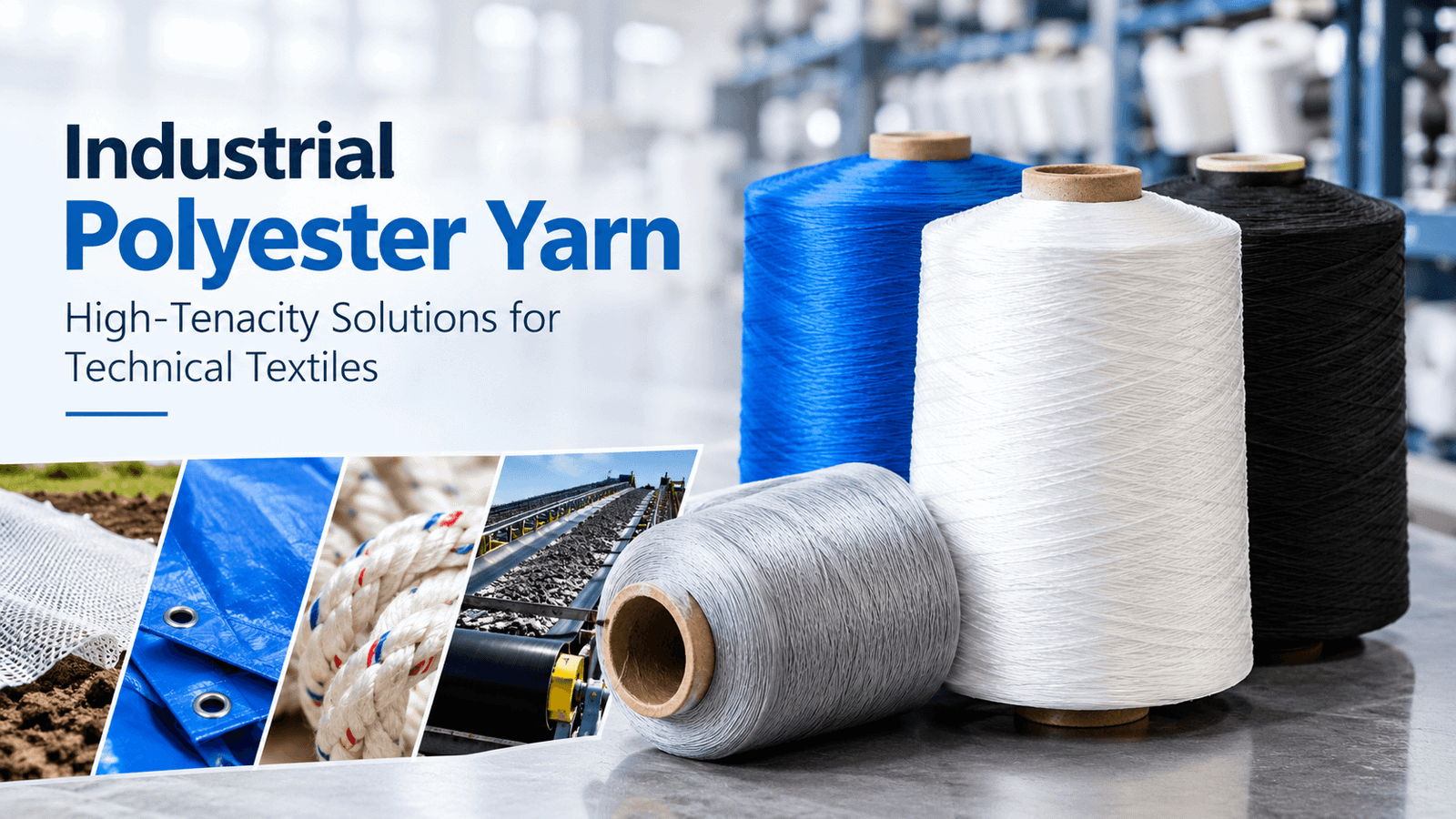
Industrial textiles need yarn that can handle demanding conditions. Strength, dimensional stability, abrasion resistance, and consistent performance are important in many applications.
Industrial Polyester Yarn is widely used for these requirements. High-tenacity polyester yarn provides a useful balance of strength, durability, low moisture uptake, and dimensional stability. It is used in products such as webbing, ropes, geotextiles, conveyor belts, tarpaulins, filtration fabrics, hoses, and reinforcement materials.
Unlike ordinary polyester yarn designed mainly for clothing or home textiles, industrial polyester yarn is engineered around performance. Different grades can be produced for specific requirements, including high tenacity, low shrinkage, high modulus, abrasion resistance, adhesive activation, and flame resistance.
What Is Industrial Polyester Yarn?
Industrial Polyester Yarn is a technical-grade yarn manufactured from polyester, commonly based on polyethylene terephthalate (PET). The yarn is engineered to deliver mechanical and dimensional properties required by industrial applications.
High-tenacity polyester yarn receives controlled drawing and processing to orient the polymer structure. This can increase tensile performance and elastic modulus. Research into polyester industrial yarns shows that molecular orientation and structure have a strong relationship with properties such as tenacity, modulus, elongation, and shrinkage.
The result is a yarn that can withstand repeated tension and mechanical stress while maintaining its shape.
Explore Industrial Polyester Yarn from TechTex Fiber
Key Properties of Industrial Polyester Yarn
The exact performance of polyester yarn depends on its grade and manufacturing process. However, industrial polyester yarn offers several important characteristics.
High Tensile Strength
High tensile strength is one of the main reasons polyester is used in technical textiles.
High-tenacity grades are designed for applications where the finished product must withstand significant pulling forces. These include lifting slings, webbing, ropes, geotextiles, and reinforcement fabrics.
Good Dimensional Stability
Industrial fabrics often need to maintain their shape during processing and use.
Specialized polyester yarns with low-shrinkage or high-modulus properties can help manufacturers control dimensional changes during heat treatment and coating processes.
Research has identified high modulus low shrinkage (HMLS), low shrinkage, and super low shrinkage as distinct industrial polyester yarn categories developed for different performance requirements.
Abrasion Resistance
Industrial fabrics can experience continuous rubbing, bending, and mechanical contact.
Polyester provides good abrasion resistance, making it useful for ropes, safety webbing, belts, hoses, and other products exposed to repeated wear.
Low Moisture Uptake
Polyester has relatively low water uptake and dries quickly compared with many natural fibers.
This property is useful for outdoor and technical applications where moisture exposure is expected. Polyester is also described as hydrophobic and quick drying in technical textile references.
Chemical Resistance
Polyester offers useful resistance to many chemicals, although performance depends on the chemical, concentration, temperature, and exposure time.
For industrial applications, these factors should be evaluated before selecting a yarn grade.
Consistent Processing
Industrial polyester yarn can be supplied in different constructions and finishes. This allows manufacturers to select yarn characteristics according to weaving, coating, sewing, dipping, or other downstream processes.
Types of Industrial Polyester Yarn
Different industrial applications require different yarn characteristics. Therefore, polyester yarn is available in several specialized forms.
High-Tenacity Polyester Yarn
High-tenacity polyester yarn is designed for applications that require strong tensile performance.
Typical applications include:
- Webbing
- Slings
- Ropes
- Nets
- Hoses
- Cordage
- Straps
- Reinforcement fabrics
TechTex Fiber supplies high-tenacity polyester yarn in specifications ranging from 210D to 6000D for several industrial applications.
Low-Shrinkage Polyester Yarn
Low-shrinkage yarn is useful when dimensional stability is important.
It is commonly used for tarpaulins, banners, filter fabrics, outdoor furniture, membrane structures, and coated fabrics.
High Modulus Low Shrinkage Yarn
HMLS polyester yarn combines high modulus with controlled shrinkage.
This makes it suitable for applications such as tire cord, dipped cord, conveyor belts, and other reinforcement materials. Research also identifies HMLS polyester as an important industrial yarn type for dynamic applications.
Abrasion-Resistant Polyester Yarn
Some applications require additional resistance to mechanical wear.
Abrasion-resistant polyester yarn can be used for seat belts, safety belts, ropes, slings, and other products exposed to friction.
Adhesive-Activated Polyester Yarn
Adhesive-activated yarn is designed to improve bonding with rubber or other materials.
It is commonly used in reinforcement applications such as conveyor belts, hoses, and other rubber-reinforced products.
Marine Finish Polyester Yarn
Marine applications can place yarn under continuous exposure to water, salt, movement, and mechanical loads.
Marine-finish polyester yarn is designed for applications such as marine ropes and nets.
Flame-Retardant Polyester Yarn
For applications where fire performance is required, specially engineered flame-retardant yarn can be used.
Potential applications include protective fabrics, safety nets, fire hoses, tarpaulins, and specialized industrial fabrics.
Applications of Industrial Polyester Yarn
Industrial polyester yarn is used across many technical textile industries because manufacturers can select different yarn properties for different applications.
Geotextiles and Geogrids
Geotextiles require strength, stability, and resistance to environmental conditions.
Polyester yarn is used in geotechnical products for applications such as soil reinforcement, road construction, embankments, drainage systems, and stabilization.
Polyester’s strength and elasticity make it suitable for several geotechnical applications, including roadbed reinforcement and embankment stabilization.
For a broader overview of technical textile applications, visit the Industrial Yarn Applications page.
Conveyor Belts
Conveyor belts operate under continuous tension and mechanical stress.
HMLS and high-tenacity polyester yarn can provide reinforcement for conveyor belt structures. The appropriate yarn depends on the belt design, operating conditions, and required strength.
Ropes, Slings, and Webbing
Industrial ropes and webbing need high tensile strength and reliable dimensional performance.
Polyester industrial yarn is used to manufacture lifting slings, safety belts, cargo straps, narrow fabrics, ropes, and nets.
Tarpaulins and Coated Fabrics
Tarpaulins need to withstand outdoor exposure, handling, tension, and weather conditions.
Low-shrinkage polyester yarn is useful for coated fabrics because controlled shrinkage can help maintain fabric dimensions during finishing and coating.
Filtration Fabrics
Industrial filtration fabrics require controlled fabric construction and reliable mechanical performance.
Polyester yarn can be used for filter fabrics in various industrial processes. The appropriate yarn depends on filtration requirements, temperature, chemical exposure, and fabric structure.
Hoses and Reinforcement Materials
Polyester yarn can provide reinforcement in industrial hoses and rubber products.
Adhesive-activated grades are particularly useful when bonding between polyester reinforcement and rubber is required.
Automotive Textiles
Automotive applications require materials that can withstand repeated mechanical stress.
Specialized polyester yarns are used in products such as seat belts, airbag fabrics, reinforcement materials, and other automotive textiles. TechTex Fiber also offers dedicated airbag yarn specifications for this sector.
Industrial Polyester Yarn vs. Standard Polyester Yarn
The main difference is the intended performance.
Standard polyester yarn is commonly designed for clothing, furnishings, and general textile products. Industrial polyester yarn is developed for applications where strength, controlled shrinkage, abrasion resistance, or other technical properties are more important.
Industrial yarn can therefore be manufactured with specific characteristics for the final product.
For example, a rope manufacturer may require high tenacity. A coated-fabric manufacturer may prioritize low shrinkage. A tire manufacturer may need HMLS properties. A rubber reinforcement application may require adhesive activation.
Choosing the correct grade is therefore more important than simply choosing polyester as a material.
How to Select the Right Industrial Polyester Yarn
Choosing the right yarn starts with understanding the final application.
1. Identify the Required Strength
Determine the tensile strength and tenacity required by the finished product.
Load-bearing products usually require a high-tenacity grade.
2. Consider Shrinkage
If the yarn will be exposed to heat during coating or finishing, shrinkage can affect the final fabric dimensions.
Low-shrinkage or HMLS yarn may be more appropriate for these applications.
3. Check Abrasion Requirements
Products such as slings, ropes, safety belts, and seat belts can experience repeated friction.
An abrasion-resistant grade may provide better performance for these applications.
4. Consider Chemical Exposure
Identify the chemicals that the finished product may encounter.
Polyester has good resistance to many chemicals, but concentrated or aggressive chemicals can affect the material. Always check compatibility for the specific operating environment.
5. Evaluate Outdoor Exposure
Outdoor products may experience sunlight, moisture, temperature changes, and weathering.
The yarn specification, stabilization, coating, and finished fabric should be selected according to the expected service environment.
6. Match the Yarn to the Manufacturing Process
Weaving, knitting, coating, twisting, dipping, and sewing can have different yarn requirements.
Discussing the production process with the supplier can help identify the most suitable yarn construction.
Why Work With a Specialized Industrial Yarn Supplier?
Industrial yarn selection is not simply about choosing a denier.
The right supplier should understand the relationship between yarn properties and the finished textile. Factors such as tenacity, elongation, shrinkage, modulus, filament construction, finish, and application requirements all affect performance.
TechTex Fiber supplies industrial polyester yarn in multiple specifications and specialized grades, including high-tenacity, low-shrinkage, HMLS, abrasion-resistant, adhesive-activated, marine-finish, flame-retardant, airbag, coated, recycled, twisted, and multi-ply yarns.
TechTex Fiber also supplies other technical yarn categories, including industrial PA6/66 yarn, high-tenacity polypropylene yarn, and para-aramid and meta-aramid yarn.
Industrial Polyester Yarn for Global Technical Textile Applications
Industrial polyester yarn continues to play an important role in technical textile manufacturing.
Its combination of high strength, abrasion resistance, dimensional stability, low moisture uptake, and application-specific finishing makes it suitable for many demanding products.
From geotextiles and conveyor belts to ropes, webbing, filtration fabrics, tarpaulins, hoses, and automotive textiles, the correct polyester yarn can contribute significantly to finished-product performance.
If you are sourcing polyester yarn for a specific industrial application, explore the Industrial Polyester Yarn range from TechTex Fiber to review available specifications and application options.
Frequently Asked Questions
What is Industrial Polyester Yarn?
Industrial Polyester Yarn is polyester yarn engineered for technical and industrial applications. It is available in different grades designed for strength, low shrinkage, abrasion resistance, modulus, adhesion, and other performance requirements.
What is high-tenacity polyester yarn used for?
High-tenacity polyester yarn is used for ropes, slings, webbing, nets, hoses, geotextiles, cordage, reinforcement fabrics, and other products that require high tensile performance.
What deniers are available for industrial polyester yarn?
The available denier depends on the yarn type and supplier. TechTex Fiber supplies industrial polyester yarn from 210D to 120000D, depending on the construction and application.
What is HMLS polyester yarn?
HMLS means High Modulus Low Shrinkage. This type of polyester yarn combines high modulus with controlled shrinkage and is used in applications such as tire cord, conveyor belts, and other reinforcement products.
Is polyester yarn suitable for geotextiles?
Yes. Polyester yarn is widely used in geotechnical applications because of its strength and useful dimensional and environmental properties. It can be used in products such as geotextiles and geogrids.
Is industrial polyester yarn resistant to water?
Polyester has low water uptake and is relatively hydrophobic. However, the water resistance of a finished textile also depends on its construction, coating, finishing, and fabric density.
Is polyester yarn suitable for outdoor applications?
Yes. Polyester is widely used in outdoor technical textiles, including tarpaulins, coated fabrics, ropes, nets, and other products. The yarn grade and finishing should be selected according to the expected UV, moisture, temperature, and mechanical exposure.
What is the difference between high-tenacity and low-shrinkage polyester yarn?
High-tenacity yarn focuses primarily on tensile strength and load performance. Low-shrinkage yarn is designed to limit dimensional changes during heat exposure. Some industrial yarns can combine high modulus with low shrinkage.
How do I choose the right industrial polyester yarn?
Consider the required tenacity, denier, elongation, shrinkage, modulus, abrasion resistance, chemical exposure, temperature, outdoor exposure, and manufacturing process. The final application should determine the yarn specification.