Our UHMWPE Yarn

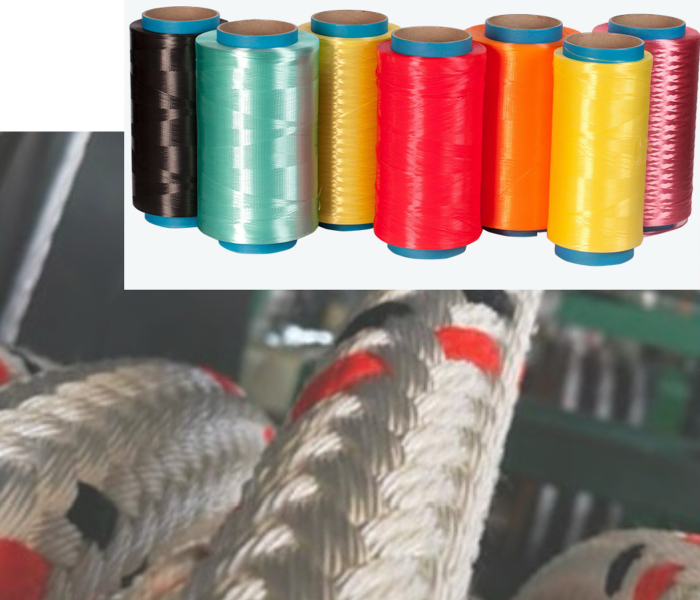
We offer you full range of colors of UHMWPE yarn. Our high tensile strength, low weight, low elongation, excellent fatigue and abrasion resistance, good chemical resistance, as well as good UV and moisture stable support your ropes, slings, finish lines, kite lines etc. products with very high loads, long life under cycling and rubbing, retains performance outdoors.

Performance benefits in real use

  1. High strength-to-weight ratio— up to 15× stronger than steel wire by weight, and ~40% stronger than aramid at equal mass.
  2. Easy handling— ropes are soft, flexible, and float (unlike steel).
  3. Safety— lower recoil energy upon break compared to steel.
  4. Long service life— excellent resistance to fatigue, salt, and chemicals.
  5. Minimal creep (in advanced grades)— stable under sustained loads with new heat-stabilized UHMWPE fibers.

Comparison with other rope fibers

Fiber Tenacity (cN/dtex) Density (g/cm³) Float Stretch (%) Remarks
UHMWPE 35–45 0.97 2–4 Lightest, strongest; low stretch
Nylon (PA66) 7–9 1.14 15–30 High stretch, good shock absorption
Polyester (PET) 7–9 1.38 10–15 Good UV, abrasion, cheaper
Polypropylene (PP) 6–7 0.91 12–15 Very light but weak, poor UV
Aramid (Kevlar®, Twaron®) 20–23 1.44 2–4 Heat-resistant, less flexible, prone to UV damage
Steel wire 2–3 7.8 < 1 Very strong but heavy and stiff


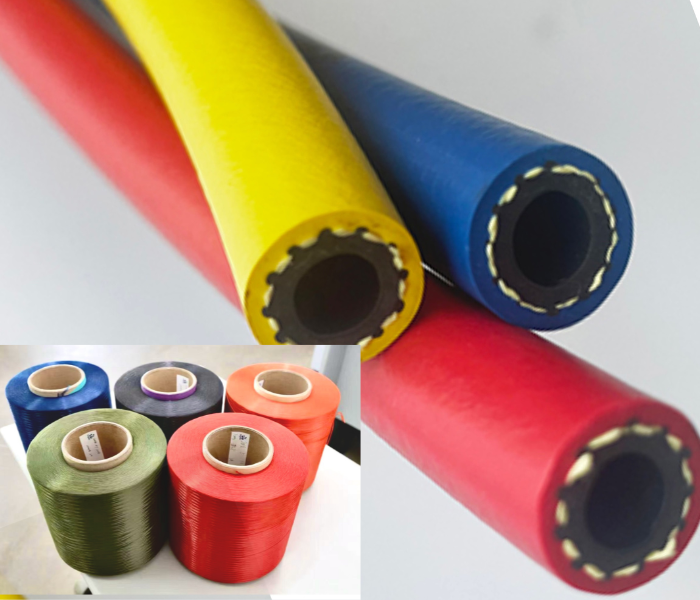
Our Para-aramid hoses yarn

Our Para-aramid hoses yarn with difference colors offers you steel-like strength and heat resistance at a fraction of the weight, with excellent flexibility and fatigue life, yours ideal choose for high-pressure, high-temperature and long-life hoses produce.

Para-aramid is usually used as the reinforcing braid or spiral layer between the inner tube and the outer cover:

  1. Hydraulic hoses(high pressure, e.g., SAE 100R7/R8)
  • Thermoplastic inner tube (PA, TPU)
  • Para-aramid braid reinforcement
  • Polyurethane outer cover
    1. Automotive hoses
  • Power steering, brake, or turbo hoses (where heat and pressure pulses are severe)
    1. Aerospace hoses
  • Lightweight, nonmetallic reinforcement is vital for fuel and hydraulic systems.
    1. Industrial hoses
  • For chemicals, compressed air, or hot fluids where steel wire would add weight or corrode.

Para-aramid gives the best strength-to-weight ratio while remaining flexible and heat resistant — a sweet spot for hoses that must bend repeatedly and endure high internal pressures.

Comparison with other reinforcements

Fiber / Material Tensile strength (GPa) Density (g/cm³) Temp limit (°C) Key pros Key cons
Steel wire 1.8–2.0 7.8 250 Very strong, low creep Heavy, corrosion, less flexible
Polyester (PES) 0.8–1.0 1.38 150 Cheap, flexible Limited high-temp & strength
Nylon (PA66) 0.9–1.1 1.14 120 Tough, cheap Absorbs moisture, low modulus
Para-aramid 3.0–3.6 1.44 200–250 High strength, low weight More expensive, sensitive to UV & compression
Glass fiber 2.4–3.0 2.5 500 Heat resistant Brittle, poor flex fatigue
PBO (Zylon®) 5.8 1.54 400 Extremely strong Very expensive, UV sensitive


Marine finish yarn vs Standard PES yarn

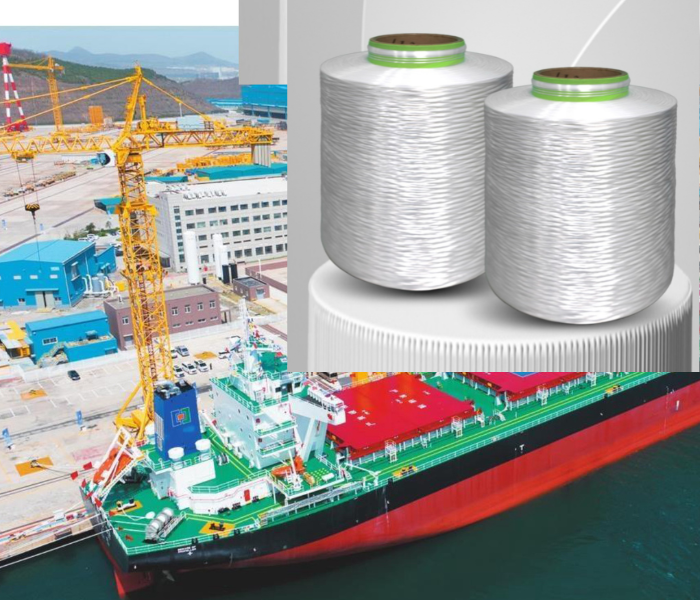
Our High tenacity PES Marine Finish yarn 1000D-3000D with ABS certificate offers you a stablized and qualified products for making marine and boating materials like ropes, webbings etc. Our products including a special marine (moisture-resistant, anti-hydrolysis, anti-fungal) finish to improve its performance in wet, salty, or humid environments to resist:

  • water absorption,
  • salt corrosion,
  • microbial/fungal growth,
  • UV degradation, and
  • hydrolysis (chemical breakdown in hot, moist air or water).

Marine finish yarn vs Standard PES yarn

Property Standard PES PES marine finish
Water absorption Low Very low (improved hydrophobicity)
Hydrolysis resistance Moderate Improved
UV resistance Moderate Enhanced
Friction / sewability Normal Optimized for wet or coated fabric sewing
Long-term durability (wet/humid) Moderate High
Appearance / handle Smooth Smooth or slightly waxy, depending on finish


High-Performance PES Airbag Yarn Offers Better Hydrolysis Resistance and Lower Production Costs

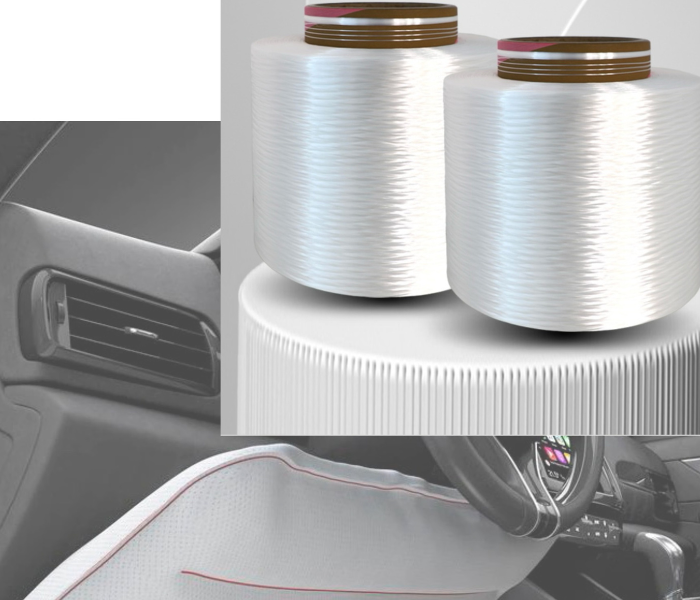
Our HT PES Low Shrinkage airbag yarn 210D-420D, super bright, broken filament 0 tolerance, make your airbag produce easier and more efficient.  PES airbag yarn is a good cost-efficient alternative to PA66 airbag yarn.
Chosen our HT PES airbag yarn when hydrolysis resistance, dimensional stability (low water uptake), lower cost, and good UV/chemical resistance are priorities. Polyester tends to be less sensitive to humid aging and retains properties better after moisture exposure.

PES airbag yarn PA66 airbag yarn side by side comparation

Property / criterion PA66 (nylon 66) PES (polyester)
Tensile strength (per mass) High — excellent strength and energy absorption Good — high but usually slightly lower than PA66 for same denier
Initial modulus / stiffness Moderate — more ductile (higher elongation) Higher modulus (stiffer) for some filament types
Elongation at break / toughness Higher elongation → good energy dissipation Lower elongation (less stretch) depending on yarn construction
Abrasion / seam wear Excellent abrasion resistance Good to very good (depends on finish)
Hydrolysis / moisture sensitivity More moisture absorption → property change with ageing Less sensitive — better retention after humidity/wet ageing
Thermal resistance (short-term heat) Good — withstands transient heat well Good — similar short-term thermal limits; polyester softens differently
Long-term heat/hot-air ageing Nylon can lose strength faster under hot, humid conditions Polyester tends to show better dimensional stability under humidity/heat
Creep / stress relaxation Nylon more prone to creep over time under load Polyester generally better at resisting long-term creep
Dyeability / processing Very good — widely used for colored threads Very good — also easy to process
Seam performance (stitch tear under dynamic inflation) Often superior because of toughness/elongation Typically good; depends on yarn twist, ply and fabric construction
Cost & availability Often a bit higher cost (depends on region) Usually cost-competitive and widely available
Compatibility with coatings/finish Accepts many finishes; may need anti-hydrolysis treatments Accepts finishes, and can be easily heat-set and coated