
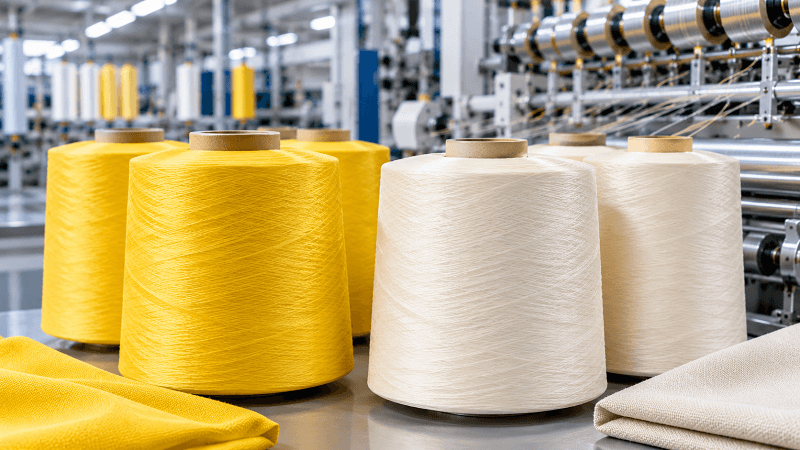
Industrial manufacturers need materials that deliver strength, heat resistance, and durability under demanding working conditions. Traditional textile fibers may not always meet these requirements, especially in protective clothing, industrial reinforcement, and high-temperature applications.
Para-Aramid and Meta-Aramid are two important high-performance synthetic fibers used across Europe’s technical textile industries. Both belong to the aramid family, but their mechanical properties and applications are different.
Para-aramid is widely recognized for its exceptional tensile strength and lightweight construction. Meta-aramid is valued for its inherent flame resistance and thermal stability.
Understanding these differences helps manufacturers choose the right material for safety equipment, industrial textiles, filtration products, and reinforcement applications.
What Are Para-Aramid and Meta-Aramid Fibers?
Aramid fibers are synthetic aromatic polyamides engineered for demanding industrial environments. Their molecular structures provide properties that distinguish them from conventional polyester, nylon, and polypropylene fibers.
Although para-aramid and meta-aramid belong to the same fiber family, the arrangement of their polymer chains creates different performance characteristics.
What Is Para-Aramid?
Para-aramid is a high-strength synthetic fiber known for its excellent strength-to-weight ratio, low elongation, and resistance to high temperatures.
Its molecular structure allows the polymer chains to align closely, creating a strong and relatively rigid fiber.
Para-aramid yarn is commonly used in applications requiring high tensile strength, including protective equipment, industrial hoses, reinforcement fabrics, and specialized composite materials.
The material can provide substantial strength without the weight associated with conventional metal reinforcement.
What Is Meta-Aramid?
Meta-aramid is a heat-resistant synthetic fiber primarily used in applications requiring flame resistance and thermal protection.
Unlike para-aramid, meta-aramid generally offers lower tensile strength but greater flexibility and elongation.
Its inherent flame-resistant properties make it useful in protective clothing, firefighting garments, electrical insulation, and industrial filtration.
Meta-aramid does not melt like conventional thermoplastic fibers. However, prolonged exposure to excessive temperatures can still cause material degradation.
Key Differences Between Para-Aramid and Meta-Aramid
The main difference between these materials is their balance of mechanical strength and thermal performance.
Tensile Strength
Para-aramid provides significantly higher tensile strength than meta-aramid.
This makes it suitable for products that must withstand heavy loads or require strong reinforcement.
Meta-aramid is generally selected for thermal protection rather than maximum mechanical strength.
Heat Resistance
Both fibers offer excellent heat resistance compared with many conventional textile materials.
Meta-aramid is particularly useful for flame-resistant clothing and high-temperature filtration.
Para-aramid also resists heat, but its primary advantage is its combination of high strength and thermal stability.
Flexibility and Elongation
Meta-aramid generally offers higher elongation and flexibility.
Para-aramid has lower elongation and higher stiffness, making it suitable for applications where dimensional stability under tension is important.
Industrial Applications
Para-aramid is commonly used in reinforcement structures, protective equipment, ropes, hoses, and composites.
Meta-aramid is frequently used in firefighting clothing, heat-resistant fabrics, filtration materials, and electrical insulation.
The final selection depends on the required performance rather than one material being universally better.
Major Benefits of Para-Aramid Yarn
1. Exceptional Strength-to-Weight Ratio
Para-aramid provides high tensile strength at a relatively low weight.
This makes it useful for manufacturers seeking lightweight reinforcement materials without sacrificing mechanical performance.
2. Low Elongation
Para-aramid yarn generally stretches less than many conventional synthetic fibers.
This characteristic is important for products requiring dimensional stability under tensile loads.
3. Heat Resistance
Para-aramid maintains useful mechanical properties at elevated temperatures within its specified operating limits.
It is suitable for selected industrial environments where conventional fibers may soften or lose strength.
4. Good Abrasion Resistance
Appropriately engineered para-aramid constructions can provide good resistance to wear.
However, performance depends on yarn structure, surface treatment, and operating conditions.
5. Reinforcement Capability
Para-aramid is widely used as a reinforcing material in technical textile and composite applications.
Its high tensile modulus makes it valuable where controlled deformation and structural strength are important.
Major Benefits of Meta-Aramid Yarn
1. Inherent Flame Resistance
Meta-aramid has flame-resistant properties built into its polymer structure.
Unlike fibers that depend entirely on applied flame-retardant treatments, its inherent resistance does not simply wash away.
2. Thermal Stability
Meta-aramid can retain useful properties at temperatures that would damage many conventional textile fibers.
Actual operating limits depend on exposure duration, environmental conditions, and product construction.
3. Flexible Textile Construction
Meta-aramid can be processed into yarns and fabrics suitable for protective garments and industrial applications.
Its flexibility makes it useful where comfort and movement are important.
4. Electrical Insulation
Certain meta-aramid materials are used in electrical insulation systems because of their thermal and dielectric properties.
Material grades must be selected according to the relevant electrical and safety requirements.
5. Chemical Resistance
Meta-aramid offers resistance to various chemicals, although compatibility depends on the specific substance and exposure conditions.
Chemical testing is important when selecting materials for demanding industrial environments.
Industrial Applications of Para-Aramid and Meta-Aramid in Europe
Both fibers support specialized manufacturing applications across several industrial sectors.
Protective Clothing and Firefighting Equipment
Meta-aramid is commonly used in flame-resistant clothing for firefighters and industrial workers.
Para-aramid may also be incorporated into protective fabric blends to improve mechanical strength and durability.
Protective clothing must be tested against the relevant safety standards before use.
Automotive Industry
Para-aramid is used in selected automotive reinforcement applications, including hoses, belts, friction materials, and composite components.
Its high strength and relatively low weight make it useful where mechanical performance is important.
Aerospace Applications
Lightweight, high-strength materials are valuable in aerospace manufacturing.
Para-aramid can be incorporated into composite structures and reinforcement systems where impact resistance and weight reduction are important.
Industrial Filtration
Meta-aramid is used in certain high-temperature filtration products.
It can be suitable for filtration environments where conventional fibers cannot tolerate the operating temperature.
Manufacturers must also evaluate chemical exposure, filtration efficiency, and mechanical requirements.
Industrial Hoses and Reinforcement
Para-aramid yarn is suitable for selected hose reinforcement applications because of its tensile strength and dimensional stability.
Reinforcement yarn helps hoses withstand internal pressure while maintaining a flexible structure.
The complete hose design determines pressure performance and service life.
Electrical and Thermal Insulation
Meta-aramid materials are used in selected insulation systems for electrical equipment and industrial applications.
Their heat resistance can help support performance in demanding operating environments.
How to Choose the Right Aramid Yarn
Selecting the correct aramid yarn requires a clear understanding of the final product.
Evaluate Mechanical Requirements
If the application requires exceptional tensile strength, low elongation, or structural reinforcement, para-aramid may be appropriate.
For applications primarily requiring flame resistance and thermal protection, meta-aramid may be more suitable.
Consider Operating Temperature
Manufacturers should evaluate both continuous operating temperatures and short-term exposure conditions.
Heat resistance varies by fiber grade, construction, and environmental conditions.
Check Yarn Specifications
Important specifications include denier, tenacity, elongation, modulus, filament count, and thermal performance.
These values help manufacturers determine whether a yarn meets their production requirements.
Review Processing Compatibility
The selected yarn should be compatible with weaving, knitting, braiding, twisting, or other manufacturing processes.
Processing trials can help identify potential issues before full-scale production.
Choose a Reliable Supplier
Consistent yarn quality is essential for technical textile manufacturing.
Manufacturers should work with suppliers that provide clear product specifications, technical documentation, and appropriate material options.
For detailed specifications, manufacturers can explore the Para-Aramid and Meta-Aramid yarn range available from TechTex Fiber.
The product range includes para-aramid yarn options from 100D to 7250D across different strength and modulus series, along with meta-aramid filament specifications and available colors.
TechTex Fiber
Why Aramid Yarn Quality Matters
Technical textile applications often involve strict mechanical and thermal requirements.
Inconsistent yarn properties can affect manufacturing efficiency, finished-product quality, and long-term performance.
For example, variations in tensile strength or elongation may influence reinforcement performance.
Similarly, inconsistent yarn construction can create processing difficulties during weaving or braiding.
Manufacturers should therefore evaluate material quality through appropriate testing and supplier documentation.
Important quality factors include uniform linear density, consistent mechanical properties, suitable packaging, and traceable production batches.
Sourcing Para-Aramid and Meta-Aramid Yarn in Europe
European manufacturers often require specialized materials for protective equipment, industrial filtration, reinforcement, and technical textile production.
Selecting an experienced industrial yarn supplier can simplify the sourcing process.
TechTex Fiber Sweden AB supplies a range of industrial yarns, including aramid, polyester, polypropylene, polyamide, and other high-performance fibers. Its stated focus includes serving European manufacturers with specialized yarn solutions.
Trusted Industrial Yarn Exporter Europe
Before ordering, buyers should confirm the required specifications, availability, testing documentation, and delivery arrangements.
For specialized applications, requesting samples can help manufacturers evaluate material performance before committing to larger production quantities.
Conclusion
Para-Aramid and Meta-Aramid are important materials for modern technical textile manufacturing.
Para-aramid provides exceptional tensile strength, low elongation, and lightweight reinforcement capabilities. Meta-aramid offers inherent flame resistance, thermal stability, and flexibility for protective and industrial applications.
Both materials serve different purposes, and selecting the correct fiber depends on the operating environment and performance requirements.
For manufacturers in Europe, understanding these differences can help improve material selection, production consistency, and finished-product reliability.
Frequently Asked Questions
Q1. What is the main difference between Para-Aramid and Meta-Aramid?
Para-aramid is primarily known for its exceptional tensile strength and low elongation. Meta-aramid is mainly valued for its inherent flame resistance, thermal stability, and flexibility.
Q2. What are the common applications of Para-Aramid yarn?
Para-aramid yarn is used in industrial hoses, reinforcement fabrics, protective equipment, ropes, composites, and selected automotive and aerospace applications.
Q3. Is Meta-Aramid suitable for firefighting clothing?
Yes. Meta-aramid is commonly used in firefighting and flame-resistant protective clothing. Finished garments must meet applicable safety standards and performance requirements.
Q4. Are Para-Aramid and Meta-Aramid heat-resistant?
Both fibers offer good heat resistance. However, their performance characteristics differ, and maximum operating temperatures depend on the specific material grade and exposure conditions.
Q5. Where can manufacturers buy Para-Aramid and Meta-Aramid yarn in Europe?
Manufacturers can explore specialized industrial yarn suppliers such as TechTex Fiber, which lists different para-aramid and meta-aramid yarn specifications for technical textile applications.